Showing posts with label Uttar PRadesh. Show all posts

Tuesday, September 6, 2011

Sarnath - Holy place of Sri Buddha's first sermon

Sarnath – the place of enlightenment
It is nice for me to travel to the Hindu religious places in India. I am very much blessed to see the holy places in India. I believe that the good things I have done in my life has given me the chance to visit the Hindu religious places and temples all over India. In my search for truth I also visited the Hindu religious place  named Sarnath. Sarnath is a Hindu religious place  which is considered most important to visit. The Hindu religious place, Sarnath is said to be a sacred place for  Buddhists. Sarnath is considered as a very sacred and holy Hindu religious place  where Lord Gautama Buddha has visited and given his first sermon. My pilgrimage to this Hindu religious place has given me enough strength to my life. My pilgrimage to Sarnath is unforgettable. So I would like to narrate my experience of this pilgrimage to this holy Hindu religious place. I am giving below the history and Mythology behind this holy Hindu religious place for your knowledge and guide for a pilgrimage to this holy place known as Sarnath, abode of Lord Gautama Buddha`.
Premaanand in front of Dhameka Stupa at Sarnath
 Sarnath is located just 12 KM from the Hindu holy city of Varanasi in the state of Uttar Pradesh India, is the site of the deer park where Gautama Buddha first taught the Dharma after his enlightenment. Sarnath is one of the four holy Buddhist sites sanctioned by Sri Buddha himself for pilgrimage. The other three sites are: Lumbini (birth); Bodh Gaya (enlightenment); and Kushinagar (death).

Singhpur, a village one KM away from the site, was the birth place of Shreyansanath, the eleventh Jain Tirthankar of the present age (Avasarpini), and a temple dedicated to him, is an important Jain pilgrimage centre.
Budha Temple near Mulagandhakuti Vihara
Sarnath has previously been known as Mrigadava, "deer park," and Isipatana, meaning the place where holy men fell to earth. The latter name is based on the legend that when Sri Buddha was born, devas or demigods came down to announce it to 500 holy men. The holy men all rose into the air and disappeared and their relics fell to the ground. 

The current name Sarnath came from Saranganath means "Lord of the Deer" and relates to another old Buddhist story in which the Bodhisattva is a deer and offers his life to a king instead of the doe he is planning to kill. The king is so moved that he creates the park as a sanctuary for deer. 
Plaque of Dhameka Stupa

Plaque of Chaukundi
 History


After his enlightenment in Bodhgaya, Sri Buddha went to Sarnath seeking his five former companions. He found them, taught them what he had learned, and got enlightened. This event is referred to as "the turning of the wheel of the Dharma" and also marks the founding of the Sangha, or the community of monks. 
Dhameka Stupa at Sarnath
 Sri Buddha's first discourse, delivered here at Sarnath, is known in Pali as the Dhammacakkhapavathana Sutta. Other Suttas include the Anattalakhana Sutta and the Saccavibhanga Sutta. Sri Buddha's central teaching after his enlightenment centered around the Four Noble Truths (concerning the meaning of life) and the Noble Eightfold Path (concerning the right way to live). 
A Large bell in Chaukundi
 Sri Buddha spent the next rainy season in Sarnath at the Mulagandhakuti vihara. The Sangha having grown to 60 in number, Sri Buddha sent them out to teach the Dharma to others.

Sarnath became a major center of the Sammatiya school of Buddhism, one of the Nikaya or Hinayana schools. The presence of images of Heruka and Tara indicate that Vajrayana Buddhism was also practiced here. 
Dhameka Stupa at Sarnath
 At the end of the 12th century, Sarnath was attacked by Turkish Muslims. The site was subsequently plundered for building materials and has remained in ruins until the present day. The site was entirely deserted until 1836, when the British began excavations and restoration. 

All of the ancient buildings and structures at Sarnath were damaged or destroyed by the Turks. However, amongst the ruins the Dharmekh Stupa is impressive at 128 feet high, and 93 in diameters. This dates from around 200 BC and is the spot where Sri Buddha is said to have preached his first sermon. 
Escavated Monastry in Dhameka Stupa Premises
Only the foundations remain of the Dharmarajika Stupa, but it is notable as a rare pre-Ashokan stupa. The Ashoka Pillar at Sarnath survived the Turkish invasion but was broken during excavations. The base still stands in its original spot and has some interesting carvings. The splendid lion capital that topped the pillar is on display at the Sarnath Archeological Museum.
Escavated Monastry in Dhameka Stupa Premises
The decaying ruins of the Mulagandhakuti Vihara mark the place where Sri Buddha spent his first rainy season in meditation. In the 7th century, a writer described it as 200 feet high and containing 100 niches containing a Buddha carving along each wall. A life-sized statue shows Sri Buddha turning the wheel of the law. 
Escavated Monastry in Dhameka Stupa Premises
Buddhism flourished in Sarnath in part because of the support of kings and wealthy merchants based in nearby Varanasi. By the 3rd century Sarnath had become an important center for the arts, which reached its zenith during the Gupta period (4th-6th century AD). When Hsuan Tsang visited Sarnath in the 7th century, he found 30 monasteries and 3000 monks living at Sarnath.
Jain Mandir Near Dhameka Stupa Premises
There is also a Bodhi tree planted by Anagarika Dharmapala which was grown from a cutting of the Bodhi tree at Bodh Gaya. It is located next to a Sri Lankan monastery. Six national temples have been built by various Asian communities at Sarnath since the site's restoration, including a Tibetan temple and Sri Lankan temple.
Inside the Chinese Buddha Temple
Isipatana is identified with the modern Sarnath, six miles from Varanasi. Alexander Cunningham found the Mrigadaya represented by a fine wood, covering an area of about half a mile, extending from the great tomb of Dharmekh on the north to the Chaukundi mound on the south.
Jain Mandir Near Dhameka Stupa Premises
Legends

Isipatana is mentioned by Sri Buddha as one of the four places of pilgrimage which his devout followers should visit, if they wanted to visit a place for that reason.
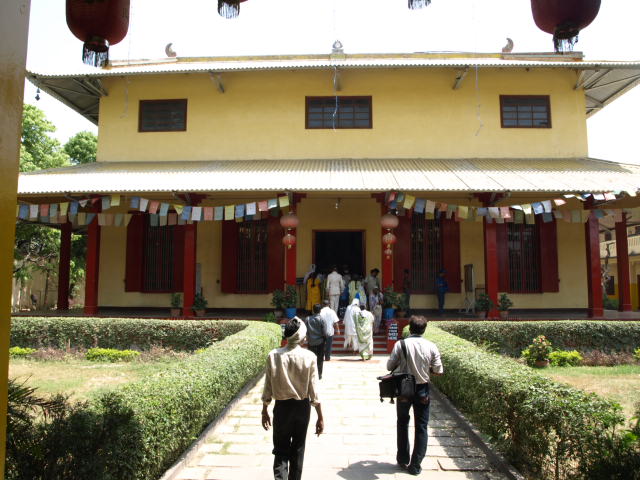
Chinese Monastry
It is said that when Sri Buddha-to-be was born, some devas (demigods) came down to announce it to 500 rishis. The rishis all rose into the air and disappeared and their relics fell to the ground. Another explanation for the name is that Isipatana was so called because sages, on their way through the air (from the Himalayas), alight here or start from here on their aerial flight. Pacceka Buddhas, having spent seven days in contemplation in the Gandhamadana, bathe in the Anotatta Lake and come to the habitations of men through the air, in search of alms. They descend to earth at Isipatana. Sometimes the Pacceka Buddhas come to Isipatana from Nandamulaka-pabbhara.
Mulagandhakuti Vihara
Hsuan Tsang quotes the Nigrodhamiga Jataka to account for the origin of the Mrigadaya. According to him the Deer Park was the forest gifted by the king of Varanasi of the Jataka, where the deer might wander unmolested. 
Mulagandhakuti Vihara
Gautama Buddha at Isipatana

Sri Buddha went from Bodhgaya to Sarnath about 5 weeks after his enlightenment. Before Gautama (the Sri Buddha-to-be) attained enlightenment, he gave up his austere penances and his friends, the Pancavaggiya monks and went to Isipatana.
Remains of Asoka Pillar in Dhameka Stupa Premises
After attaining Enlightenment Sri Buddha, leaving Uruvela, travelled to the Isipatana to join and teach them. He went to them because, using his spiritual powers, he had seen that his five former companions would be able to understand Dharma quickly. While travelling to Sarnath, Gautama Buddha had to cross the Ganges. Having no money with which to pay the ferryman, he crossed the Ganges through the air. When King Bimbisara heard of this, he abolished the toll for ascetics. When Gautama Buddha found his five former companions, he taught them, they understood and as a result they also became enlightened. At that time the Sangha, the community of the enlightened ones, was founded. The sermon Sri Buddha gave to the five monks was his first sermon, called the Dhammacakkhapavathana Sutta. It was given on the full-moon day of Asalha. Sri Buddha subsequently also spent his first rainy season at Sarnath at the Mulagandhakuti. The Sangha had grown to 60 in number (after Yasa and his friends had become monks), and Sri Buddha sent them out in all directions to travel alone and teach the Dharma. 
Places believed where Buddha gave his first Sermon

Isipatana after Sri Buddha


Xuanzang found, at Isipatana, fifteen hundred monks studying the Hinayana. In the enclosure of the Sangharama was a vihara about two hundred feet high, strongly built, its roof surmounted by a golden figure of the mango. In the centre of the vihara was a life-size statue of Sri Buddha turning the wheel of the Law. To the south-west were the remains of a stone stupa built by King Asoka. 
Remains of a temple in the Dhameka Stupa Premises
In front of it was a stone pillar to mark the spot where Sri Buddha preached his first sermon. Nearby was another stupa on the site where the Pancavaggiyas spent their time in meditation before Sri Buddha's arrival, and another where five hundred Pacceka Buddhas entered Nibbana. Close to it was another building where the future Sri Buddha Metteyya received assurance of his becoming a Sri `Buddha.
Rangaraj Temple Sarnath
Sarnath has been developed as a place of pilgrimage, both for Buddhists from India and abroad. A number of countries in which Buddhism is a major (or the dominant) religion, among them Thailand, Japan, Tibet, Sri Lanka and Myanmar, have established temples and monasteries in Sarnath in the style that is typical for the respective country. Thus, pilgrims and visitors have the opportunity to experience an overview of Buddhist architecture from various cultures.

Thursday, June 30, 2011

Triveni Sangam Allahabad

Triveni Sangam
Confluence of Holy Rivers 
Ganga, Yamuna and the invisible Saraswathy
Triveni Sangam Allahabad Uttar Pradesh India

Allahabad or “Settled by God” in ancient Persian (now called Dari), is a name given by Mughal kings to the ancient Prayag, being the second oldest city of India, in the state of Uttar Pradesh. It is located 205 KM south of state capital Lucknow. Allahabad is accessible by Road, Rail and Air.

The city of Allahabad is among the largest cities of Uttar Pradesh and situated at the confluence of three holy rivers - Ganga, Yamuna and the invisible Saraswati. The meeting point is known as Triveni Sangam and is especially sacred to Hindus. The earlier settlements of the Aryans were established in this city, then known as Prayag. All sins are cleaned with entry in Prayag (the ancient name of modern time Allahabad) Prayag is one of the historic and mythological cities of India with glorious past and present. It continues to enjoy the distinction of being a place of haunting and lasting memories. 

History

The Present Jhunsi area very close to sangam was the kingdom of Chandrabanshiya (lunar clan) king Pururava. Nearby Kaushambi bloomed to prosperity during Vatsa and Maurya Rule. The earliest monument of antiques, Ashok Pillar with inscriptions of third century B.C. clears the inscriptions of his directions to his fellow Rajas and praise of King Samudragupta. The Chinese traveler Huan Tsang in 643 BC found Prayag inhabited by many Hindus who regarded the place very Holy. In ancient times, the city was known as Prayag (place of the confluences). For Hindus, Prayag and the district of Kaushambi are important parts of their territory. The area became a part of the Mauryan and Gupta Empires of the east and the Kushan Empire of the west before becoming part of the Kannauj Empire.

Allahabad became a part of the Mughal Empire after their invasion of India in 1526. In 1575 AD Emperor Akbar founded the city by the name of “Illahabas” which has now become Allahabad, “The City of Allaha” impressed with the strategic importance of the Sangam. In medieval India the city enjoyed the honour of being the religio-cultural center of India. For a long time it was provincial capital of the Mughals. Later it was captured by Marathas.

The Founder of Sikh Religion Guru Nanak Dev ji Visited Allahabad then known as Prayag and the Ninth Sikh Guru Tegh Bahadur visited Allahabad in 1666 and Sikh Religion was preached in this City.

In 1765, the British established a garrison in Allahabad fort. From 1801 AD British history of the city begun, when the Nawab of Oudh ceded it to the British Throne. British army used the fort for their military purposes. During 1857 AD the town was the centre of war of Independence and later became the crucible of Indian Freedom Movement against British. In 1857, Allahabad was active in the Indian Mutiny.

In 1858 AD The East India Company officially handed over India to British Government here at Minto Park. After the first war of independence the town was named “Allahabad” and was made the capital of United Province of Agra and Oudh. In 1868 AD it became a seat of Justice when Allahabad High Court was established.

1871 AD British architect Sir William Emerson erected a majestic monument All Saint Cathedral, thirty years before he designed the Victoria Memorial in Kolkata. In 1887 AD Allahabad becomes the fourth oldest University. Allahabad has been rich in numerous Victorian and Georgian buildings made in synthesis with Indian architectural traditions.

This city was the heart of the Indian Freedom Movement against the British rule with Anand Bhawan being the epicentre. It was in Allahabad, Mahatama Gandhi proposed his program of non-violent resistance to liberate India. From the days of civilization Allahabad has been seat of learning, wisdom and writing. It is the most vibrant politically spiritually conscious and spiritually awakened city of India.

In 1931, at Alfred Park in Allahabad, the revolutionary Chandrasekhar Azad killed himself when surrounded by the British Police. 

Legends

The ancient name of the city Prayag (Sanskrit refers to it as a "place of sacrifice") and is believed to be the spot where Brahma offered his first sacrifice after creating the world. It is one of four sites of the mass Hindu pilgrimage Kumbh Mela, the others being Haridwar, Ujjain and Nashik. It has very importance in Hindu scriptures for it is situated at Triveni Sangam, the confluence of the holy rivers Ganga, Yamuna, and the invisible Saraswathy.
Its sanctity is manifested by references to it in Purans, the Ramayan and the Mahabharat. According to Hindu Mythology, Lord Brahma, the creator God of the Trinity, chose a land on earth (i.e. Prayag) to perform ‘Prakrista Yag’, at the beginning of the creation and he also referred to it as Tirtha raj or the King of all pilgrimage centres’ As per writing of ‘Padma Puran’ – “As the sun is amongst the moon and the moon amongst the stars, likewise ‘Prayag is best amongst all places of pilgrimage”. In Brahma Puran it is mentioned that bathing in the month of Magha at the Sangam of Ganga-Yamuna-Saraswathy in Prayag bestows results of millions and millions of Ashvamedha Yajna.

Prayag is birth place of Som, Varuna and Prajapati. Prayag has been associated with mythological personalities in Brahmanical (Vedic) and Buddhist Literatures. It was the seat of the great Sage Bhardwaj, Sage Durvasa and Sage Pannas. Sage Bhardwaj lived here circa 5000 BC and taught more than 10000 disciples. He was the greatest philosopher of ancient world.

Kumbh Mela

Every year thousands gather at Allahabad to take part in the festival on the banks of the Ganges, the Magh Mela. The same festival is organized in a larger scale every 12th year and attracts millions of people and is called the Kumbha Mela. Kumbh Mela (especially the Maha Kumbh Mela) is the most sacred of all the pilgrimages. Thousands of holy men and women (monks, saints and sadhus) attend, and the auspiciousness of the festival is in part attributable to this. The sadhus are seen clad in saffron sheets with plenty of ashes and powder dabbed on their skin as per the requirements of ancient traditions. Some called Naga sanyasis or 'Dhigambers' may often be seen without any clothes even in severe winter, generally considered to live an extreme lifestyle. 

Sangam
Triveni Sangam Allahabad Uttar Pradesh India

Triveni Sangam Allahabad Uttar Pradesh India
Located approximately 7 km from Civil Lines, it is actually the confluence of three holy rivers Ganga, Yamuna, and Saraswati. As per Hindu tradition Triveni Sangam is the confluence of three rivers. Sangama is the Sanskrit word for confluence. The point of confluence is a sacred place for Hindus. 
Devotees taking a holy dip in Triveni Sangam Allahabad Uttar Pradesh India


Devotees taking a holy dip in Triveni Sangam Allahabad Uttar Pradesh India


A bath here is said to wash away all of one's sins and free one from the cycle of rebirth. Here the muddy and pale-yellow waters of the Ganges merge with the blue waters of Yamuna. While the Ganges is only 4 feet deep, the Yamuna is 40 feet deep near the point of their nexus. The river Yamuna merges into the Ganges at this point and the Ganges continues on until it meets the sea at the Bay of Bengal. At the confluence of these two great Indian rivers, where the invisible Saraswati conjoins them, many Tirtha yatris take boats to bathe from platforms erected in the Sangam.

Allahabad Fort

Allahabad Fort at Allahabad, Uttar Pradesh, India was built by Emperor Akbar in 1583. The fort stands on the banks of the Yamuna near the site of confluence with river Ganges. It is the largest fort built by Akbar. In its prime, the fort was unrivaled for its design, construction and craftsmanship. This huge fort has three galleries flanked by high towers.
Wall of Allahabad Fort Uttar Pradesh India


Wall of Allahabad Fort Uttar Pradesh India
The outer wall is intact and rises above the water's edge. Inside the fort there is the Zenana, Palace of Mariam-uz-Zamani and the 3rd century BC Ashoka pillar and Saraswati Koop as well, said to be the source of the Saraswati River. The Patalpuri temple is also here.

Patalpuri Temple and Akshaya Vat

Located inside the Allahabad Fort, this is actually an underground temple, alluding to associations with Lord Rama. The famous Akshaya Vat one of the most revered trees of the Hindus is also sited within the temple. It is believed that lord Rama has visited this temple. Famous Chinese traveler and writer Huan Tsang also visited the temple. The undying banyan tree or 'Akshayavat' within the Patalpuri temple has found state in the account of several ancient scriptures, writers and historians. This place of worship inside the Fort is an important place of pilgrimage. It dates from the epic age. Huan Tsang, the Chinese traveler who visited the Fort in 634 AD during his journey through India, mentioned its imprinted stone divinity. It became an underground holy place when Akbar construct his Fort over and around in 1583. A permit from the Ordnance Depot or the Tourist Office is required for visiting the Patalpuri Temple and the Akshaya Vat. It is near the southern wall and is one among the many frees seen from outside the southern wall of the fort.

Hanuman Mandir

Located near the Allahabad Fort, it is famous for the image of the reclined position of Lord Hanuman. The idol of Shri Bade Hanumanji, situated in Sangam Kshetra is very magnificent and gorgeous. This idol is lying in Veermudra. The broad forehead, large arms, wide waist spontaneously arouse the feelings of valour in the minds of devotees. Thus the devotee becomes completely overpowered by devotion. The place where the idol of Shri Bade Hanumanji is laid, it is believed that it sets the mixed holy waters of mother Ganga, Yamuna and Saraswati in an intrinsic and unseen way continuously. 

Under the right foot of Shri Bade Hanumanji’s idol the statue of Ahirawan is situated; which is being looked at as the destroyer of ill-feelings and bad-actions; under the left foot of the idol of Shri Bade Hanumanji the statue of Kamada Devi who is considered the Goddess of will-power and is Aradhya Devi of Ahiravana. Near the idol of Shri Bade Hanumanji and towards forehead the idols of Shri Ram Ji and Laxman Ji are situated. By seeing these symbols it seems that this idol of Shri Bade Hanumanji is full of feelings of victory upon foes.


Sumptous Lunch
Pranav Nair


Prachetas Nair
Hi friends
Enjoy Allahabad. Waiting for your comments. Now I am inserting videos also. Enjoy the places and festivity. Life is to enjoy. Enjoy as much as you can.


See you with next posting soon.


Premaanand